Showing posts with label peaceful parenting. Show all posts

Friday, May 25, 2012

Ten Reasons I Choose to Nurse Past Infancy

This was originally published as a guest post on one of my favorite blogs about a year ago.
One year later, these ten reasons are still applicable.

When I was pregnant, it seemed like everyone wanted to know if I was going to nurse and then for how long. I don't think I even knew humans breastfed prior to becoming pregnant; I had never seen it, but for some reason, my answer to the questions was always "Yes, I'm going to give breastfeeding a try for at least six months and then it depends on how it goes after the baby gets teeth." For some reason, I was doubtful and kept those free formula samples in the cupboard "just incase" (never did use them). I had read about the risks of feeding babies with formula and I knew I wanted to give breastfeeding a try. What I didn't know was about the amazing aspects of a nursing relationship *other* than food. We have blown past 6 months, 12 months and 24 months. I definitely didn't plan on extended nursing, but why stop a good thing? We wean when she is ready. Gumby still nurses very often and we both absolutely love our special time together.
1. Bonding, Cuddling and Snuggling Time
As your little angel gets more and more mobile, you may find that the little baby that wanted held and snuggled and rocked begins to change into a little toddler that can't stop moving! Gumby is always on the go, and nursing the little squirmy critter that seemed to somehow grow eight eight-feet long legs is how she got her nickname Gumby the Octopus. But sometimes, that little octopus of mine retracts her extra legs and just wants to lay and nurse. Sometimes she runs her hands over my face; sometimes she wants me to sing to her; sometimes she wants me to hold her and hug her as tight as I can while I'm mooching her; sometimes she just gazes lovingly into my eyes ... and, all times, I melt and am so grateful for our special time together.

2. A Soothing and Calming Experience

Christmas Morning Cuddles, Gumby age 27 months.

When I nurse Gumby, there is a certain calm and peacefulness that enters into both of us. Science will tell you that it is because of the hormone prolactin that is released during nursing and that the act of nursing blocks stress receptors, but I think it is so much more. Nursing a toddler continues to be about, not just feeding, but also about nurturing the relationship between mother and child, just as it was with an infant.


3. A Way to Reconnect
Anytime I am gone from Gumby, when I return, I am greeted with a vivacious "I need nummies!" Whatever it is she was doing is immediately stopped. Whatever thoughts or negativity that I returned with are put aside. Our focus is soley one each other. It is almost as if we were never apart. With mamma's milk flows the hormone oxytocin which releases feelings of love and nurturing.
Nursing also helps promote reconnections during the day. Sometimes toddlers and mamma's do not quite see eye to eye on everything; sometimes the two of us have what I call an "off" kind of day where we just can't seem to get on the same page with each othes. Whatever the case may be nursing serves as a wonderful time for us to stop what we are doing and just remind each other and ourselves that we love each other.

4. Finally Confident Enough

Nusring Gumby at 22 months on a bench at a Zoo.

It took me until Gumby was 3 months old to stop hiding to nurse. I spent so many of her early days, hiding in the bedroom when visitors would come. Not because I was embarrassed, I have always been proud of breastfeeding my baby. But, I have also been a very private person. I don't even like V-neck shirts. But, as Gumby grew, I, too, grew ... and got tired of sitting in a room alone. I finally realized that I could nurse discreeting, protecting my privacy, but also any time and any place in order to meet my baby's needs. Okay, so maybe it didn't take me until she was considered a toddler, but the longer we nurse, the more confident I am, both in my actions and my decisions.


5. Dental Benefits
Breastfeeding itself requires the use of different facial muscles than sucking on a bottle or pacifier. The exercising of these muscles results in better jaw alignment and a lowered need for future orthodontic work.1 Breastmilk contains lactoferrin which kills the bacteria that causes tooth decay. In addition, the milk proteins coat and protect the enamel. I am not saying this is a substitute for regular brushing, but I am saying that toddlers have teeth and this can't hurt.2 As a side note to anyone who may be worried about nursing a little one with teeth ... it is physically impossible to nurse AND bite at the same time ;)

6. No Other Lovies Needed
Gumby doesn't really have a favorite toy, blankie, etc. If we go somewhere, while we do pack things and sometimes it seems as though we pack the entire house, there isn't any one item that we really need to remember to take with us. Whether she makes the request "Nummies go too." or she doesn't, nummies go too. I have never left home without them.

7. Health Benefits for Mom

Still Happily Nursing at 29 Months :)

Besides the fact that Gumby was over 2 when my ol' Aunt Flo came to visit for the first time in a long time, breastfeeding lowers the risk of several cancers (breast, ovarian, uterine, endometrial), rheumatoid arthritis, and protects against osteoporosis.5 Often, the health benefits continue to increase the longer nursing is continued.

8. Health benefits for toddler
The same reasons that mother nature designed breastmilk for infants still applies for as long as the child nurses. They will continue to have less illnesses, fewer ear infections, fewer allergies, lowered risk of asthma, lowered risk of obesity, lowered risk of diabetes, lowered risk of heart disease, lowered risk for central nervous system degenerative disorders, lowered risk of digestive diseases, lowered risk of multiple sclerosis, lowered risk for sleep apnea, better eyesight, and increased cognitive development.3, 4, 5

9. In Times of Sickness
Breastmilk is alive and changing all of the time. As toddlers become more active and social in the word, they are exposed to more germs and potentially illesses. Should a toddler pick up a virus, it will be transfered to the mother while nursing. Not that mom will get sick (though she may through any of the close contact that comes with having a little one), but her body will make the antibodies *on the spot* and pass back to the toddler via breastmilk. This could happen before your nursling even shows signs of illness. Breastmilk is very gentle on the stomach and intestines. It provides a protective lining against germs in the intestines. It could be the only thing your little one wants to consume and/or can hold down. All of this, in addition to the emotional closeness and comfort.

10. Comforting an Upset Toddler
Over the summer, we were on vacation and staying at a hotel. We had just finished swimming, but Gumby still had some energy to run off, so we were in the common area playing and she was running around. And then, it happened. She took off at full speed and turned, smacking her forehead right into the corner of a table. It grounded her instantly and she screamed like I had not heard before. We sat right down to nurse, while Deeda tried to figure out what to do next. She was so upset; and, have you ever seen forehead bumps swell? They swell right before your eyes and look horrible. But, she latched on. The screams turned to whimpers and the whimpers turned to calm... within *minutes*. I was grateful to be able to sooth her when she was so upset and in so much pain. Toddlers fall. The comforting aspects of nursing are still very neccessary at this age.

References:
1. http://www.askdrsears.com/html/2/T020500.asp
2. http://www.kellymom.com/bf/older-baby/tooth-decay.html
3. http://www.askdrsears.com/html/2/T020400.asp
4. http://www.askdrsears.com/html/2/T020500.asp
5. http://www.kellymom.com/bf/bfextended/ebf-benefits.html

Thursday, May 17, 2012

What Derails my Peaceful Parenting

Lately, Gumby and I seem to clash ... so much more than we used to.  I suppose it has something to do with all of the development that is happening with a three and a half year old and the adjustment to having a new member of the family.  But, it also has something to do with my response to her.  Sometimes, my responses are not what I want them to be and are also probably not what Gumby is expecting of me.  I have become aware of a few things that derail me from my peaceful parenting track.  I hope to use this awareness to pause, see that my responses are not coming from the heart but from these other issues which are my own, acknowledge them and get back on track.

1.Expectations & Controlling Outcomes
I can get so caught up in expectations that I forget parenting is about the journey and the relationships we are cultivating along the way.  As my energy goes towards controlling a certain expectation or outcome that I have perceived as important or correct in my own mind, I find myself wrapped up in that control, in a battle, which makes me angry.  The more my focus turns towards these outcomes and away from Gumby, the more it seems like I am struggling against a tide of increasing strength.  Except I am the one giving it strength.  And, Gumby isn't struggling against me, she's simply struggling.  She's asking for my help because the tide is sweeping her away.  When I let go of my expectations and understand that I cannot (nor do I need to) control outcomes, I am more able to focus on Gumby's needs and how I can help this situation in this present moment.

2. Minimizing Feelings
I know that it is not beneficial to minimize feelings.  Gumby's feelings are important, real and often times for her very strong.  It is a challenge for me to empathize when I interpret her feelings as exaggerated or silly.  Duck poo around the pond, bright sunlight and unpleasant smells may not be unbearable for me, an adult with a fully mature and (mostly) regulated system, but for a little one with an immature brain and not fully regulated system, these things can be a real bother.  When my mind dubs a catalyst to Gumby's feelings as insignificant, I struggle to respond in the nurturing way that Gumby needs.  What I strive to remember is that these things are big to her and she needs a hand  when things are feeling out of control for her.  She would not ask for something if she did not need it.

3. Privilege
Thoughts of my own privilege can provoke irritation, anger and a shortage of patience.  I cannot empathize or empower Gumby when I am viewing what I "deserve" as being at odds with Gumby's needs and feelings. Framing my needs as a privilege that I deserve invites a conflict that I am loosing, that I must fight to win.  While it is important to acknowledge my own needs and feelings, I want to act in a way that works to meet every one's needs as best as possible.

4.Thinking I Do Not Have a Choice
When I find myself thinking I have no choice in a situation, I feel helpless, entrapped and act with annoyance at best.  I do not have to play, pick up, carry, nurse or anything.  I must remember that I choose to do these things because they are important.  And, if I need a rest, then I need to acknowledge that as well.  It does not model self limits and respect to Gumby if I sigh or roll my eyes while fulfilling a request of hers.  I must remember that everything is a choice, my choice.  It makes me happy knowing that I do have a choice which enables me to interact and respond from a place of peace.

Tonight at bedtime, all four of these things crept into my mind.  But I was ready for them.  Laying in bed trying to help a little one sleep when it takes long has always been a challenge to me... Because I want to control the outcome (she should be asleep by now) ... I inadvertanly minimize her feelings anad needs (This is ridiculous, just go to sleep) ... I stew about what I deserve to be doing instead (I've laid here long enough, go to sleep so I can shower, clean, watch shows, blog, cuddle with my husband, etc) ... and I think I have to lay there.  But, I didn't.  I didn't have to lay there.  And, I didn't have to control the outcome.  She's never stayed up forever before, surely, tonight would not be any different.  Her inability to settle in to bed tonight was not ridiculous to her, otherwise, she would have been asleep!  Yes, I had things I wanted to do.  But, most of all, I wanted to act out of compassion to meet my daughters needs.  And, I did.

What things sneak up on you to derail your peaceful parenting?
How does identifying them help you get back on track?

Sunday, April 15, 2012

Lil' Dove's First Diaperless (almost) Outing


We were halfway to the mall so that Gumby could enjoy their play area when for some odd reason, we suddenly realized that no one brought the diaper bag.  Deeda was the first to say "Skip it! What's the worst that could happen?" And, after I gave a few of my concerns of exaggerated worse case scenarios, my panic gave way to logic and I realized we could buy some cheap wash cloths to use as diaper inserts or disposable paper diapers if need be. We held course. 

What *is* the worst that could happen?

After what was kind of a rough day between Gumby and I, we were all going to the mall to play!

We've been practicing Natural Infant Hygiene since day one with Lil' Dove.  And, wouldn't it be nifty if we could go for just a few hours free from the dependency of the diaper (other than the one she was currently wearing and without having her sit in mess for any time at all)?

Not that we don't have "off" days where I just can't seem to be in touch with Lil' Dove's needs to eliminate (pee-pee or poo), but there are good days.  And, that evening was a good day.  We played; she pottied; we returned home with Lil' Dove in the same dry diaper we left the house with.  No diaper bag.  Yes :)

Tuesday, April 10, 2012

10 Gentle Tips for Kids Who Hate the Bath

Welcome to the April 2012 Carnival of Natural Parenting: Kids and Personal Care
This post was written for inclusion in the monthly Carnival of Natural Parenting hosted by Code Name: Mama and Hobo Mama. This month our participants have shared stories, tips, and struggles relating to their children's personal care choices.


Somewhere along the line when Gumby was around 2.5 she started hating baths.  Loathing them, really and straight out refusing to be in the tub.  I think I put her in a few times when the water was too hot and I also figured out she *hated* when she would get her hair washed and the water would drip down her face.  I'm guessing part of the problem was normal toddler stuff as well. She enjoyed swimming, and calling the tub our "indoor pool" worked for a very short time.  And then, it didn't.  It was summer and she was getting frequent chlorine baths at the local pool and we figured the phase would pass.  It didn't. 
Eventually, we were able to establish a bath routine with which she felt comfortable.  Here are some things that were helpful for us.

First, the really helpful items:

1. Routine
We are a very "go with the flow" family and have a difficult time sticking to any type of routine.  It makes sense that kids feel more comfortable when things are familiar and they know what to expect.  We were desperate, so we implemented a few bath days and designated 'hair washing' days, and we stuck to them .  She hated it, so we went slow, not trying for every single day.  Routines removes choices when choices become a problem (ie: do you want to have a bath in the little bathroom or big bathroom ... answer: 'I don't want to have a bath anywhere.') The routine cut down on arguing with us about having a bath.  It is simply bath time because that is what it is.  It's not randomly thrown into the day, but designated and we can look on the calendar and know when exactly it is.  Feelings and expressions of disapproval and upset were acknowledged with empathy, but in the end, it was bath day.

2. Just for Fun
The goal was just go get Gumby into the tub.  Seriously.  On many of the bath days after our new routine started, they were 'just for fun'.  She didn't have to get wet, soapy, etc.  We just wanted her to feel comfortable being in the tub.  Maybe even play a little. 

3. Stool to sit on
Gumby did not want to touch the water.  At all.  We took her step stool into the tub to use as a seat.  A dry seat.  Towels required in case of a droplet of water hitting her seat.  She could sit with her feet on the stool and put them into the water when/if she was ready.

4. Sponge baths
We had to keep her clean'ish somehow! :)

These things are also fun and helpful:
Gumby happy suds-ing up

5. Songs
The hair washing was the biggest challenge.  Even with a little visor hat to keep the water out and telling her to look up, it only takes a moment of her looking down for the water to flood her face resulting in much upset.  We have a silly little song that we sing while we wash Gumby's hair.  She looks forward to it and it seems to help.  She even smiles now (months later) during hair washes!

6. Predictability & Narration
Since she dreaded the hair washing so very, very much, we thought it would be helpful to let her know what would be next and when it would be over.  We tell her we're going to wet her hair with six cup fulls of water.  We count them with her.  We also tell her right where they will be going.  "This one is going down the top!  Look up up up!"  "Here comes the next one down this side." ... the narration goes with our silly song.

7. Toys
Not just bath toys, but any toys.   We let her choose animals that may need baths, containers for pouring, boats or the many uses of a container, blocks, etc... anything a little different to keep it interesting and fun.

8. Paint
Gumby may not want soap on herself, but she loves painting herself.  Don't mention that the paint is food coloring and bubble bath soap.  :)

9. Themes
We've only done this a little bit with adding food coloring to the water and one with balloons in the tub.  You can actually find a lot of really cool themed baths for kids online. 

10. Location
Once we established a routine and that bath time was going to happen, we found that Gumby did have a preference on which tub to use.  The corner tub in the master bathroom is more open and larger and she had a clear preference for that one over the one that we used to use all the time ... you know, the one where I made the water too hot and then poured it over her face to wash her hair ;)

What tips do you have for bathing kiddos' that do not want any part of the water/tub?


***

Carnival of Natural Parenting -- Hobo Mama and Code Name: MamaVisit Code Name: Mama and Hobo Mama to find out how you can participate in the next Carnival of Natural Parenting!

Please take time to read the submissions by the other carnival participants:

(This list will be live and updated by afternoon April 10 with all the carnival links.)

  • Holistic Care of your Toddler's Teeth — Erica at ChildOrganics tells a tale of her children's teeth issues and how she uses homeopathy and good nutrition to keep cavities at bay.
  • Bath Time Bliss : Fuss-Free Bath Time for Toddlers — Christine at African Babies Don't Cry shares how she has made bath time completely fuss free for both her and her toddler.
  • Homemade Natural Toothpaste — City Kids Homeschooling hosts a guest post on a homemade natural toothpaste recipe that kids will love!
  • Bathing Strike Strategies — Crunchy Con Mommy offers her best tips for keeping your little ones clean when they refuse to bathe.
  • Bodily Autonomy and Personal Hygeine — Mandy at Living Peacefully with Children discusses the importance of supporting a child's bodily autonomy in the prevention of abuse.
  • A Tub Full of Kiddos! — Kat at Loving {Almost} Every Moment has kiddos who love the water, so bathtime is a favorite evening activity!
  • The Trials of Tidying My Toddler — Adrienne at Mommying My Way shares the difficulties she has with getting her on-the-go son to be still enough to get clean.
  • Wiped Clean — Laura at Pug in the Kitchen shares her recipe for homemade diaper wipe solution to clean those sweet little cloth diapered bottoms in her home!
  • Snug in a Towel: Embracing Personal Grooming — Personal care is time consuming,especially with more than one child; but the mama at Our Muddy Boots is learning to embrace this fleeting and needful time.
  • EC: All or Nothing? — Elimination Communication. Even the title sounds complicated and time consuming. It doesn't have to, if you adapt it to meet your family's needs, says Jennifer at True Confessions of a Real Mommy.
  • Routine Battles — In a guest post at Anktangle, Jorje of Momma Jorje outlines a simple incentive to help inspire your little one to follow a routine.
  • Redefining Beauty For My Daughter — Justine at The Lone Home Ranger relays her struggle to define her own femininity and how her preschooler unexpectedly taught her a lesson in true beauty.
  • Rub-A-Dub-Dub, Three Girls In The Tub — Chrystal at Happy Mothering shares how she turns bath time into a few minutes of peace and quiet.
  • Montessori-Inspired Activities for Care of Self — Deb Chitwood at Living Montessori Now has a roundup of Montessori-inspired activities for care of self and ideas for home environments that encourage independence.
  • 10 Gentle Tips for Little Ones Who Hate the Bath — Kim at life-is-learning gives 10 tips to get your little one into the bath and maybe even enjoying it.
  • The Boy With The Long Hair — Liam at In The Now discusses his son's grooming choices.
  • Personal Care in a Montessori Home — Melissa at Vibrant Wanderings shares a summary of the ways she has organized her family's home to make for easy, Montessori-inspired toddler personal care.
  • Styling Kids — Kellie at Our Mindful Life is letting her kids decide what to look like.
  • Clean Kids: Laundry and Bath Tips — Kimberly at Homeschooling in Nova Scotia shares tips on how to get your children helping with laundry plus recipes for laundry and liquid soap.
  • How to Clean Your Children Naturally: A Tutorial — Erika at Cinco de Mommy shows you how to clean your children.
  • Cleaniliness is next to... dirt — The lapse-prone eco-mom (Kenna at Million Tiny Things) sometimes forgets to bathe the kids. Except in the mud pit.

Monday, May 2, 2011

11 Ideas for Integrating Children and Pets

I have been an animal lover for my entire life.  I grew up around a farm and always had cats.  Shortly after my husband and I were married, I needed to have some pets in my life.  We got a couple of free kittens.  Then, he got me the one pet I had always wanted, but never had - a basset hound.  My first dog.  We learned a lot together.  Over the years, my love for dogs resulted in running a non-profit dog rescue.  My extremely supportive and tolerant husband, myself and a small handful of volunteers saved over 100 dogs in about five years.  
While the dog rescue is much smaller than it used to be, we do have 1 foster and I will put her shameless plug right here.  Chloe is a 5 year young beautiful american pit bull terrier who is looking for a family to call her own :)
Our family now includes Chase the basset hound, the only dog ever accquired from a breeder before we learned about the millions of homeless dogs, Gracie a small furry mixed breed rescued from our local dog pound, Jasmine an american pit bull terrier rescued from a life of abuse and neglect, Max a cat who was abandoned on our doorstep when he was a kitten, Felix a cat who was abandoned at the manufacturing plant where I used to work, and most recently Reese and Pete The Cat (we have a Mickey Mouse addiction here), two keepers of the litter of five that was left on our doorstep.

It is important to me that Gumby be involved with the animals and have a positive experience with them and they with her.  We want her to know how to effectively communicate and safely interact not only with our own pets but with any others she may encounter.

Here are a few ways that we are getting there:

Gumby holding Elle, one of the kittens from our Fall drop off litter.
Elle was spayed, updated on shots and happily rehomed

1. Supervise, Supervise, Supervise
Animals can be unpredictable.  Children can be unpredictable.  Never leave them together unsupervised. 

2. Gentle Touches
We strive to show and tell Gumby what she *can* do and not concentrate on what not to do.  We are very careful with the words we choose and try to set up a successful environment.  For petting the animals, when she was small we would always tell her to use "one finger".  That is how she petted them for a long time.  It's impossible to be rough, smack, or pull anything using just one finger.  Now she understands the word "gentle" and uses her whole hand to stroke their fur very gently.


3. Dogs Eat Alone
This one is plain, simple and self explanatory.  It is a positively framed statement of how the dogs eat that was  told to her daily when it was time to feed the dogs.   Now, she will tell anyone simply that "Dogs eat alone."  We never said "Do not go near the dogs when they eat", "Do not take their food", or other statements that concentrate on what she is "forbidden" to do or actions she should not take.  We do not try to invoke any fear of what happens if one takes food from a dog who doesn't do well with that sort of thing (though we have told her that not all dogs like to share as a reason *why* they eat alone); in fact, we encourage her to watch them eat from a reasonable distance.

4. Only Pick up Toys from the Floor
Gumby loves handing the dogs toys and playing fetch with them.  What we needed to help her learn was that once they take the toy, it is their toy.  We are always there during play to ensure she is not reaching into their mouths.  Accidents, grumpy dogs, whatever the reason, it is simply never a good idea for a child to have their hands in a dogs mouth.  Our dogs know a "Give" command and Gumby knows how to use it.

5. Involvement in Training
Training pets is a wonderful way to bond with them, work together with them and to establish rules through fun.  Gumby loves giving the dogs and cats treats.  The dogs know they are not to take food from her hands and they are to wait until she drops the treat to the ground.  We have what I call well behaved beggers.  Our dogs beg, but have always only been rewarded for sitting or laying.
Gumby, just over 2 years old, using the hand signal for "Down" and two of her dogs obeying and awaiting their treat!

6. Involvement in Feeding
It is important for the pets to see good things coming from this little, loud, fast, unpredictable creature that moved into their home.  As mentioned above, Gumby loves giving the dogs and cats treats.  In this house, she cannot take an active part in feeding the dogs just yet because they eat raw meat, but she can and does feed the cats and give the dogs water, treats and special stuffed kongs. 
Gumby, age 2, feeding Max and her own kitty some milk.


7. Know your Children, Know your Pets, Know and Respect Their Limits
Nobody knows your child or your pets better than you.  If your dog will happily chew a bone on the couch with a toddler sitting on him, great.  But, if your dog can get a little grumpy with a bone and your well-meaning playful toddler thinks trying to take things from the mouth of the dog is a fun game for both of them (and maybe with a ball, for example, it is), maybe giving Fido a high value bone when the child is nearby is just something the dog isn't going to handle well.  All people and animals have limits.  Limits are natural and deserve our respect.

8. Create a Yes Environment
Creating a "Yes" Environment for a child is doing what needs done to ensure success such as baby proofing, putting away items that the little one is not ready for yet or that isn't safe, putting away things that cause the parent to have to say "No" repeatedly, creating unnesseccary tension and stress.  This can apply for pets as well.  You will note that none of the pictures I will ever post of our dogs has a dog bed.  A certain grumpy hound dog does not like to be bothered once he is all curled up and comfy on his dog bed, ie: he growls.  A growling dog is giving a warning and sending a message for his need for uninterrupted rest the only way that he knows how.  While we talk to Gumby about letting sleeping dogs lie, if you will, there is no need to take unnesseccary risks.  When we saw the dogs beds become a problem, we picked them up.  If there are toys the dogs treasure or guard, remove them.  Anything that could possibly be a point of contention or set anyone up for a mistake should be removed.  I am not advocating that the dog's owner not seek to help work on these problems, but I am saying this should be done at a specific training times and not when a little one is possibly going to be interacting with the pet. 

9. Pets Need Their Own Space
We didn't throw those dog beds out, however.  The dogs can all enjoy them from their own little doggie room.  They can go there to sleep, to enjoy special treats such as kongs, or just when they dont want to play and need some quiet time.  When they tell us they want quiet time, we put up a baby gate and they can have the rest they need and can return when they are ready.

10. People Need Their Own Space
The pets needing a break from the child seems to go hand in hand with the child needing a break from the pets in this house.  Sometimes the dogs are giving too many kisses, sometimes the kittens have attacked our feet just about as many times as we can take, sometimes they just won't play the way Gumby is expecting them too and it upsets her.  We let Gumby know that it's okay to "take a break" from the pets.  Instead of hitting them, kicking them, swatting at them or doing whatever other behaviors a toddler may do because they are expressing themselves the only way they know how, Gumby knows to ask Mamma or Deeda to move the pets or to take a break from them.

11. Let Everone Know When they are Interacting Properly
Positive feedback goes a long way.  When the dogs are playing gently, sitting for treats, laying to be covered with blankets or whatever else, tell them they are being good.  Slip them an extra snack.  When Gumby is giving out toys, we tell her that makes the dogs happy and they love their toys.  When she is touching them gently, we tell her that makes them feel safe.  While the dogs are rewarded solely for their behavior, Gumby is given feedback about how her actions are affecting the dogs feelings and well-being to help her see the positive impact that she can have on their lives.
Gumby ensuring everyone is safe, warm and comfortable :)
What have you found useful to integrating your pets with your children?  What challenges have you had?

Sunday, April 10, 2011

Ten Reasons I Choose to Nurse My Toddler...

When I was pregnant, it seemed like everyone wanted to know if I was going to nurse and then for how long.  I don't think I even knew humans breastfed prior to becoming pregnant; I had never seen it, but for some reason, my answer to the questions was always "Yes, I'm going to give breastfeeding a try for at least six months and then it depends on how it goes after the baby gets teeth."  For some reason, I was doubtful and kept those free formula samples in the cupboard "just incase" (never did use them).  I had read about the risks of feeding babies with formula and I knew I wanted to give breastfeeding a try.  What I didn't know was about the amazing aspects of a nursing relationship *other* than food.  We have blown past 6 months, 12 months and 24 months.  I definitely didn't plan on extended nursing, but why stop a good thing?  We will wean when she is ready.  Gumby still nurses very often and we both absolutely love our special time together. 

For 10 reasons why extended nursing is important to us, head over to my guest post on one of my favorite blogs Code Name: Mama! :)

Wednesday, March 9, 2011

Stop Calling Children "Drama Queens"


Two toddlers are running around at the playground, turn a corner and run right into each other.  The force knocks each of them to the ground.  As one toddler's parent asks the little one if she is okay from the fall, the other toddler's parent rolls his eyes, chuckles and tells her not to be such a "drama queen".  The kids get up and continue playing.  You wouldn't be able to tell which child had which discussion, at least not on the surface.  While one child feels respected, validated and that her feelings matter, the other one doesn't bother to show any feelings because they will not be taken seriously anyway. 
The sidewalks are crowded and icy.  While one adult is rushing to get home from a long days work, another is engulfed in their cell phone while waiting for a cab.  The person in a hurry turns quickly and bumps into the other adult, knocking them down.  The fallen adult shrieks in pain and and grabs his ankle.  Is he a "drama queen" also?

There are a lot of situations that are similar that happen to adults and children.  Adults are almost always taken seriously, but it seems that children rarely are.  Their reactions and emotions are often made trivial by surrounding adults.  But, they are not trivial and each interaction teaches the children something far bigger that what is seen on the surface.

 An Unfinished Brain

Humans are born with a very immature brain; it is only 25% of the final adult brain size.

90% of the growth of the human brain occurs in the first five years of life.1  The lower part of the brain is emotional, triggering strong emotions.  The higher part of the brain, the last part of the brain to develop, is in charge of reasoning, empathy and keeping the strong emotions in check.  The higher part of the brain continues to develop in the teenage years and even into the early 20s!2  Children are not setting out to be "excessivly emotional" as Merriam Webster defines a "Drama Queen". "Drama queen" emotions and reactions in children are simply an example of the higher part of the brain not being developed enough to calm and control the impulses of the lower brain.  

They are simply being children who have the same needs of love, empathy and understanding as the rest of us adults.

During the first five years of a child's life, the higher brain is forming a huge amount of connections between its cells.  These connections affect how the child will function socially and emotionally.3  The base of these connections rely very heavily on what the child is exposed to, reactions they experience, words that are said to them.  When children are exposed to bullying at a young age, the brain structures and chemical systems in their brain actually change.4  It is vitally important not to mock or bully a child. 

Minimizing Feelings & A Blow to Self-Esteem
When a child is called things such as "drama queen" and their feelings are not taken seriously, they may start to feel they do not deserve to be taken seriously.  If those around them are telling them they are insignificant, then they believe that they are insignificant.  They slowly start believing that what they say or feel really doesn't matter.  They may hide their feelings or loose their self respect leaving them even more vulnerable to bullies, drugs etc. The last thing a parent wants is a child afraid to be honest or express themselves openly in the parent-child relationship.

Shaming & a Fear of Vulnerability
Children learn by example.  What example does it set for a child on how to treat someone in a time of upset if when they are upset, they are not taken seriously, validated or shown empathy, but instead shamed?  Shame is an intense and painful feeling.  One way to protect oneself from shame is to put up a shield against ones own vulnerability.  Any weaknesses are hidden so that no one can cause the child to feel shame.  Children learn that pointing out another's vulnerability, they can protect their own.  They may try to rid themselves of their shame by projecting it onto others and become a bully.

Namecalling & Labelling are Self Fullfilling Prophecies
Children naturally look to adults for direction and information and internalize things said to or about them.  Namecalling and labelling are self fullfilling prophecies.  If a child is constantly called or labelled as something, then that becomes true to them and they actually will strive to fit the label.  Maybe the fall doesn't hurt, but the child knows they are a "drama queen", so they know they need to yell and scream and make an excessive commotion, which will result in them being called a "drama queen", and so on.

The Effects of Labelling on the Labeller
Labels such as "drama queens" have a negative connotation.  How would your reactions towards someone or a situation change if you thought of someone as "drama queen" versus thinking of them as human beings who have the same needs and feelings as yourself?  How would you respond differently?  Think about the examples at the beginning of this page.  You have convinced yourself that your child is a drama queen.  Clearly, when they fall and are upset, you are annoyed because you have already decided this reaction is in excess and only to get a reaction or attention which you have no intention of giving.  Later, you see an adult, who you have no pre-conceived notions of, fall.  You rush over to see if they are hurt, need help to get up, need a doctor.  Perhaps you empathize with them, at their embarrassment of the fall.  The two scenarios are similar, but your reactions are polar opposites.  The difference is the labels you already had set, or not, in your own mind.

Whether negative comments by adults to and/or about children are meant to be insulting or whether they are said in what is meant to be "good natured fun", there are serious and long term consequences to minimizing childrens' feelings, shaming, namecalling and labelling. Stop doing it!

This post was inspired by an actual event as described in the first paragraph.  The other parent went so far as to imply my toddler was also a "drama queen" after the two toddlers collided and Gumby asked for a mooch.  The problem is that neither Deeda nor myself are good with confrontations.  We said nothing and just ignored the folks, though we both wanted so badly to explain to him what the consequences are of his actions.
What did you think of the post?
What would you have done in the situation?
How could we educate folks should this happen (and we all know it will) in the future?


References:
1, 3, 4.  The Science of Parenting by Margot Sunderland
2.  http://www.edinformatics.com/news/teenage_brains.htm


Tuesday, March 1, 2011

Gumby's World: 2/12/2011-2/28/2011

The Gumby's World series is a journal of how we spend our days with Gumby :)


Two weeks ago was exciting as we had a glimpse of the spring weather that is soon to come! 
It was also exciting because Gumby's vocabulary and thirst for knowledge just continues to swell right in front of our very eyes.  She has picked up "Yep!" and "Nope!" from I'm not sure where, but it is so cute.  And, she is asking all sorts of questions that she has never asked before.  She wants to know where everybody goes and what they are doing.  She notices background noises and asks what it is.  In the car, when we arrive at our destination she asks "Where you gonna park, mamma?"  She is always so inquistive and eager to learn about her environment.

We took advantage of the warm weather and spent lots of time outside.


Gumby couldn't wait to take her love for art back to the outdoors on the front porch with her chalk!


We also spent the better parts of  several days out and about!
Gumby has been big into going to the library again.  She likes to play the computer games with me.  There are a few that she likes to use the mouse or keyboard for, but a lot of them she points or tells me what to click on.  There is one where you can play music to put animals to sleep, feed them or play with them and she thinks it's hilarious.  Sometimes, the music makes them dance and she yells "Don't do the jig, go to sleep!" :)

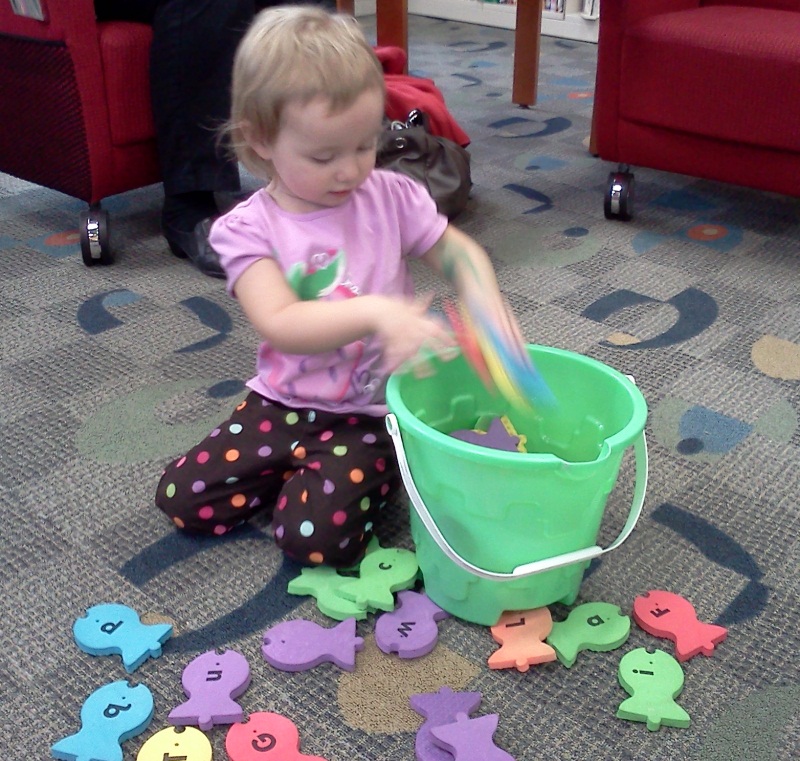
The library has these foam fishes that we've been sorting and putting together by color.  Over the summer we made choo-choo's out of the fish, as in the photo, but the color sorting was new.  She took it very seriously.  I think it's important to remember that in the eyes of children, their play is just as serious as any work us adults undertake.

Gumby almost always helps me clean up.  It is her choice and she rarely refuses.  But, on the times that she does, I am okay with it.  Surely, there are times she asks me to do things and I refuse.  Autonomy is a basic human need, important to those who are both big and small, old and young.  I want her to help me and others, not because of a threat of punishment or consequences nor because of a promise of a reward or bribe, but because she truely wants to, because the motivation comes from within her.  For that to be the case, it always has to be her choice, her decision.


We met Deeda for lunch at the park and then stayed to play.  Her and Deeda just love being barefoot.  They are talking me into it.  There is a lot of sensory experiences to be had when your feet are bare which is probably why Gumby and most other children enjoy it so much.


She played on 2 different play grounds, climbed, went down slides and rode this duck.  There is also a quarter mile track that surrounds the local highschool football field.  I think it's a quarter of a mile all the way around it.  She walked just about the entire track!

We took Gumby bowling for the second time, this time to a bowling alley that has these ball ramps that the ball can be placed on and toddlers can give them a shove to get them down the lane.  Gumby enjoyed this.  We explored a toy store that had wooden toys out to be played with, played in the mall play area, and went to the book store. 

We brought home a 3' by 2' floor puzzle which is really neat and lots of fun.
At home we did molding with her model magic foam/clay, colored, read books, read her new purchased and library books and played with the nanobugs and iPad. 

While reading, she started pointing at the words in the book and saying the letters.  She knows most of the letters, lower and upper case.  Chica Chica ABC has been a great book for showing lowercase letters in very large print and she likes to name them as they go up the coconut tree in the story.

Another new thing she has started doing is wanting to hold hands when we are out and about <3  And, wanting to walk from the parking lots to the store (holding hands required here of course!).

As the weather got colder, we spent less time outside!  Gumby is not big on cold weather.  She only likes to play outside in the cold occassionally.  When we woke up to about 8 inches of snow, she wanted go to outside to see it, did not want to walk in it, and wanted to sled ride with Mamma ... once.  That was it :) 

When the temperatures get more around the mid 30's and higher though, she likes walking in the show paths that Deeda shovels for her and making "paw prints" <3


We are still thinking spring and took a little sneak peak at the sandbox and added a few snow sculptures to it :)


Gumby and I spend our days immersed in play.  She is constantly learning what she wants, when she wants and how she wants without having to separate life experiences into subjects or play time versus learning time.  It is all intermingled, inseparable and fun.  We follow her interests wherever they lead and encourage her to explore her world.  It is impossible to go through life, even one day, and not learn something - try it!  All learning is valuable.  Life is learning.

Monday, January 31, 2011

Nighttime Potty Learning


When Gumby started using the potty, it was 100% full time, just like a switch had been flipped; she was a potty machine.  She had already been having lots of naked time and hating diapers, so we just dove into getting her underwear.  But, we did wonder: what should we do at night?

I couldn't seem to find a lot of information out there for night time potty learning.  I had noticed her overnight diapers were getting less and less wet; sometimes they would be dry.

The first day that she used the potty consistently, at bed time, we asked her if she wanted a diaper.  She said no.  We co-sleep and we have a mattress pad.  So, I explained to her what I thought would happen.  I told her if she had to potty, we'd wake up, sit on the potty, potty and then go back to bed.  I told her if I noticed her pottying in her sleep, we'd wake up, sit on the potty, potty and then go back to bed. It seemed so simple.  What surprised me was that her and I both could sleep right through those little accidents until it was too late.

For the first time, the other night, she had a full bladder and was uncomfortable, stirring and thrashing.  I kept asking her if she needed to sit on the potty and finally, she said "yes"!  We still have accidents, but we deal with them.

Here are a few things that we have found helpful on our nighttime potty learning adventure:

Patience and Trust
We will get there when we get there. :)  We cannot control when Gumby uses the potty; we can only try to help her learn to recognize the feelings of needing to go and what to do.  We need to trust that she will go when she needs to go. 

Mattress pads and those little 'multi-use' waterproof baby pads
We keep the entire mattress under a fitted waterproof mattress pad.  We also have a flat pad that is the size of the toddler bed that we keep on top of that, right where Gumby is most likely to lay.  Sometimes, if we have an accident, the toddler bed sized pad catches it all and we don't have to change the full fitted mattress pad.  The little "multi-use" water proof pads come in  handy should an accident occur in the middle of the night.  I, personally, have no desire to wake up the family and re-make the bed at some odd hour of the night.  If a wet spot is found, it can be covered with the small pad so that we can sleep on a dry surface and deal with the mess in the morning.

Recognition that Nighttime Potty Learning is a Natural Milestone
As I mentioned, when we started this journey, I thought I could help Gumby learn to recognize needing to potty while sleeping and wake up.  Ah, I still chuckle.  And, I am still amazed that she can pee when she is literally sound asleep.  Even if I did notice *and* could bring myself to wake my sleeping baby, she'd probably be done by then anyway.  I have read forum posts of folks with kids her age that stay dry all night and some whose five year old kiddos are not dry at night.  All kids are different and this is like walking; they will do it when they are ready to do it.

No Need to Night Wean
This ties in with the previous item.  Gumby still nurse at night, quite a bit.  Most nights she is dry regardless.  Again, I have read forum posts of folks who have tried night weaning and the little ones still weren't dry all night.  So, for us, why ruin a good thing? :)

Limit certain fluids 2-3 Hours Before Bed
The other night I wanted some hot tea.  Gumby loves hot tea and she shared some also.  But it was late, and then she went to bed.  The rest of the tale won't surprise you, but we did learn that certain drinks such as hot tea and slushies probably should be cut off 2-3 hours before beddy time.  We don't limit nursing, milk or water.

Nighttime Potty for Everyone
In one of my less than proud and gentle moments, I learned that it is true - you can sit them on the potty, by hook or by crook, but you cannot make them go.  Even though it is so hard not to impose our will, try to force her to go because we think she has to, not to get upset if she doesn't go when we think she has to, we had to let go of trying to push the night time potty issue and just accept what would be.  Sometimes, she pottys right before bed at 10pm and still has an accident.  Some nights, her last potty was at 4pm and she refused to go and she'd be dry still!  We decided to change what we could control (us) and not worry about what we cannot control (Gumby).  So, the rest of the family has nighttime potty.  We don't make a real big deal, but we each announce that we are having our nighttime potty.  And, we put the dogs out for their nighttime potty too.  Almost every time, it turns out Gumby also needs a nighttime potty.

So, some weeks I don't have to wash the bedding at all, other than the usual maintenance washing.  Some weeks, I have to wash the bedding every other day.  We could use diapers or pull ups and keep the bedding dry and clean.  But, in our journey, we honestly feel that would hurt Gumby's sense of pride and accomplishment and that is far more important to us than the bedding.

What information, tips or things have you found useful in your nighttime potty learning adventures?

Saturday, January 15, 2011

A "Happy" Childhood, A Successful Future and What Happens in Between.

The Wall Street Journal recently published an article entitled "Why Chinese Mothers Are Superior", with a sub caption of "Can a regimen of no playdates, no TV, no computer games and hours of music practice create happy kids?"

Before I read this, I wanted to make sure I knew the proper meaning of "happy", so I looked it up on the online dictionary.
Happy, by Meriam-Webster's definition means "characterized by well-being and contentment".

Okay, now that we know what "happy" means, let’s see if  a regimen of no playdates, no TV, no computer games and hours of music practice creates happy kids.  As I read the article, it seems that "happy" is being redefined by a model of success as the parent sees it - excelling in school, performing at recitals, being the best in the class, and other future goals.  It is focused on preparing the children to become adults and does not focus on the enjoyment of the journey, the happiness of childhood.  The children must meet the high expectations of their parents in subjects of the parents choosing, or be faced with being called "lazy", "garbage" or worse.

Where is the well-being and contentment?

There is an overarching message of negativity and distrust in the children:
"children on their own never want to work, which is why it is crucial to override their preferences."

When we first think of our children in this way, it affects the very way in which we respond to them.  This basis sets up a relationship based on struggles, battles, competition, winning.  Where is the compassion, the trust?  If the parents do not trust the children, do the children trust the parents?  Who can they trust? 
Do they keep any feelings that will bring themselves or their family shame inside, afraid to express themselves, until they cannot handle the pressure anymore?
I have no doubt that these parents love their children as much as I love my own, but I worry that equating a person's value with conditions of success and not separating the person from their actions has detrimental consequences.
Asian Americans are more likely to commit suicide than blacks, whites, and Hispanics. 
Over 60% of Cornell student suicides from 1996-2006 were Asian or Asian-Americans while only 14% of the total student body are self-identified Asian-Americans.

The article states "the vast majority of the Chinese mothers said that they believe their children can be 'the best' students, that 'academic achievement reflects successful parenting,' and that if children did not excel at school then there was 'a problem' and parents 'were not doing their job.'"

To me, it reads that the motivation for the child's success is the parents own fear of failure.  The cycle seems to be self-perpetuating and blaming in all regards. 

The online pole asking "Which style of parenting is best for children?" and giving the options of "Demanding Eastern Parenting" or "Permissive Western Parenting” implies that if one isn’t demanding obedience, coercing, spying, limiting activities, promoting competition over cooperation, then they are permissive, a word when coupled with parenting has obvious negative connotations.  Where is the option for being respectful to others, teaching children this respect through modeling the behavior, communicating in a compassionate manor and cultivating a love of learning that comes from inside the individual?  Where is the option for a parenting style that focuses on the child's destination to adulthood, trusting them enough to allow them to choose the paths they need to ensure current and future well-being and contentment?